

Alan Watts
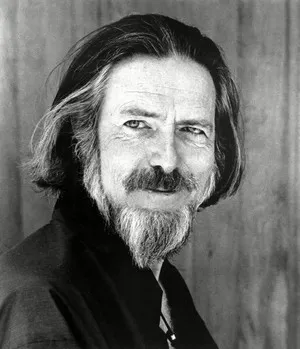
Alan Watts: The Philosophical Entertainer Who Bridged East and West
Few thinkers of the twentieth century left as lasting an imprint on the Western mind as Alan Wilson Watts. A self-described “philosophical entertainer,” Watts spent his life translating the ancient wisdom of Zen Buddhism, Taoism, and Hinduism into language that ordinary Westerners could not only understand but feel. More than fifty years after his death, his voice — literally — continues to resonate across millions of podcast feeds, YouTube channels, and meditation apps worldwide.
Early Life and the Seeds of Curiosity (1915–1939)
Alan Watts was born on January 6, 1915, and grew up in the small town of Chislehurst outside London. From an early age he was captivated by the East. His mother taught at a boarding school whose students were largely children of missionaries returning from China and Japan, and the delicate ceramics and painted landscapes they brought home filled the Watts family parlour with a vision of nature that the young Alan found enchanting.
His parents recognized his curious, sharp mind and encouraged him to write. His father would take Alan to the Buddhist Lodge in London, where, as a teenager, Alan became editor of the Lodge’s journal, The Middle Way. At just sixteen, he produced his first booklet, An Outline of Zen Buddhism (1932), and followed it five years later with his debut full-length work, The Spirit of Zen (1936). At those Lodge gatherings, he encountered seminal figures such as D.T. Suzuki, whose scholarship on Zen would shape the entire Western understanding of the tradition.
In 1938, he moved to the United States, initially to study Zen in New York, where he began lecturing in bookshops and cafés — an early sign of the gifted public communicator he would become.
Alan Watts – Man in Nature Pt 1
Alan Watts – Beyond Good and Bad: Seeing Reality as It Is | MEDITATION AND FLOW
Alan Watts – Guided Meditation (Listening and Vocalizing)
From Priest to Professor (1940–1959)
Watts’s middle years were marked by restless searching. He enrolled at Seabury-Western Theological Seminary in Chicago, was ordained as an Episcopal priest in 1944, and served as chaplain at Northwestern University. His messages from the pulpit were unorthodox, however, and by 1950 his time as a priest had run its course. He retreated to a small farmhouse in upstate New York and wrote what became one of his most enduring works, The Wisdom of Insecurity: A Message for an Age of Anxiety (1951) — a book that feels, if anything, more relevant today than when it was written.
He relocated to San Francisco in 1951, where he began teaching Buddhism at the American Academy of Asian Studies and soon became Dean of the institution. His public evening lectures spilled over into the city’s coffee houses frequented by Beat poets and writers. In 1953 he accepted a Saturday slot on Berkeley’s KPFA radio station, beginning a broadcast series that eventually became one of the longest-running public radio programmes in American history — nearly sixty years at its peak. His 1957 bestseller The Way of Zen brought him national recognition and helped ignite what historians now call the “Zen Boom.”
Alan Watts – What Is Reality?
Alan Watts: Our Place In The Universe
Alan Watts: Dropping Out From Karma
The Counterculture Years and Legacy (1960–1973)
Throughout the 1960s, Watts lectured at colleges and universities across the US and Canada, and conducted seminars at growth centres including the world-renowned Esalen Institute at Big Sur, where he gave a founding lecture alongside Gregory Bateson in 1963. He became a de facto spiritual figurehead of the counterculture movement, celebrated alongside peers such as Aldous Huxley and Joseph Campbell.
By the late 1960s he was living on a ferryboat in Sausalito, in a waterfront community of artists and bohemians north of San Francisco, before eventually retreating to a cabin on the slopes of Mount Tamalpais to focus on writing. It was there he completed his autobiography In My Own Way (1972) and his final book, Tao: The Watercourse Way, finished posthumously with collaborator Chungliang Al Huang. After returning from a lecture tour spanning the US, Canada, and Europe, Watts passed away in his sleep on November 16, 1973, on the mountain he loved.
Alan Watts – MIND OVER MIND | Self-Improvement, Grace, and the Paradox of Control
Alan Watts – Taoist Way Full Lecture
Alan Watts | Ways of Liberation | Way of Liberation (full)
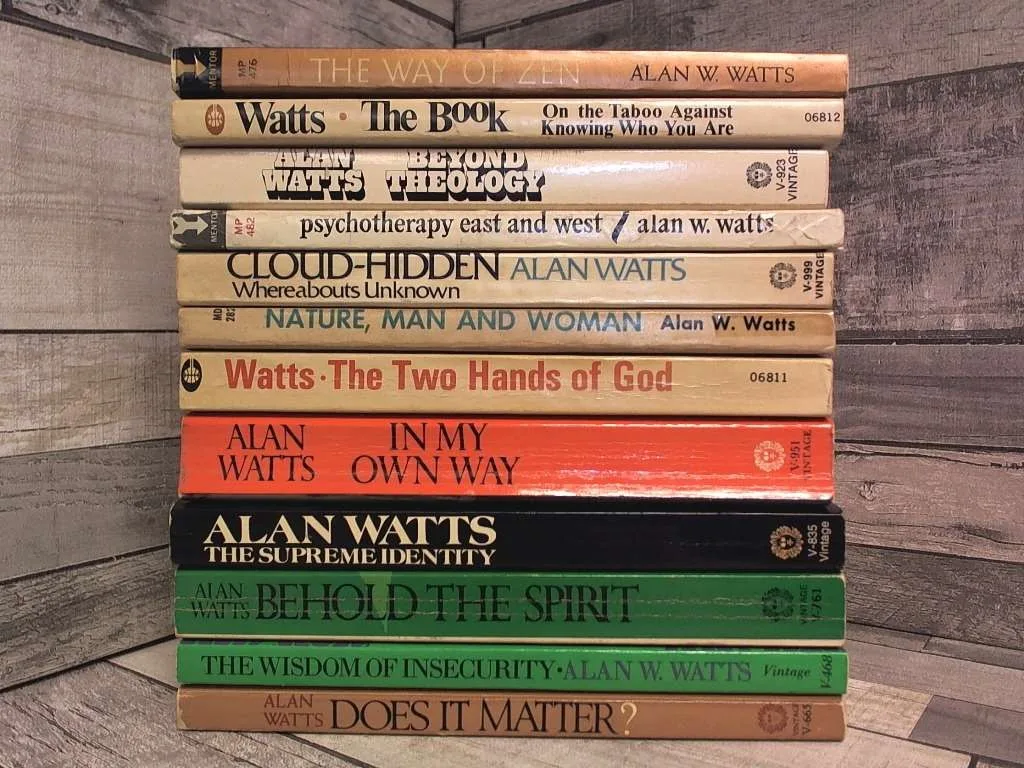
Essential Books
Watts wrote more than 25 books and articles on religion and philosophy over his lifetime. The works most essential to understanding his thought include:
- The Wisdom of Insecurity (1951) — his argument that anxiety is rooted in resisting the present moment, drawing on Eastern and Western sources alike.
- The Way of Zen (1957) — still regarded as one of the finest introductions to Zen Buddhism available to a Western reader.
- Psychotherapy East and West (1961) — a bold comparison of Eastern liberation practices with Western psychotherapy.
- The Book: On the Taboo Against Knowing Who You Are (1966) — perhaps his most accessible and provocative work, challenging the Western illusion of the separate self through Vedanta philosophy.
- The Joyous Cosmology (1962) — a poetic account of consciousness and psychedelic experience, arguing that genuine insight requires philosophical seriousness rather than escapism.
- Tao: The Watercourse Way (1975) — his final and most mature reflection on Taoism, completed after his death.
Radio, Television, and Recorded Lectures
Watts was as powerful in spoken form as in print. His Bay Area radio programmes — The Great Books of Asia and then Way Beyond the West — are broadcast to this day, with original recordings held by the Pacifica Radio Archives at KPFK in Los Angeles and at the Electronic University archive founded by his son Mark Watts. His television series Eastern Wisdom and Modern Life aired nationally in 1959, introducing millions of American households to concepts that had previously seemed impossibly remote.
In the digital era, these recordings have found a vast new audience. The official Alan Watts Organization YouTube channel (@AlanWattsOrg) offers hours of archival lectures, while the streaming platform at alanwatts.com hosts the full catalogue of his talks. A dedicated Alan Watts App makes the lectures accessible on mobile devices. His words have also been woven into popular culture — the 2017 video game Everything features quotes from his lectures, and a 360-degree immersive dome experience titled Trust the Universe: The Philosophy of Alan Watts has toured internationally.
Where to Find His Work Today
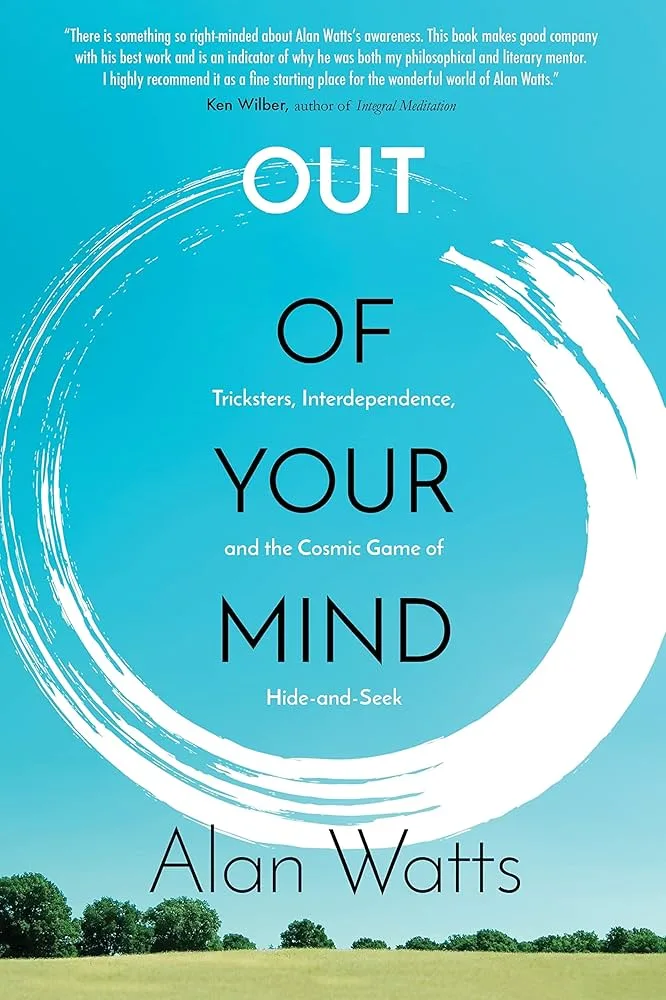
The Alan Watts Organization, led by his son Mark Watts, serves as the primary custodian of his legacy. The official website alanwatts.org offers a biography, a complete bibliography, licensing information for his recordings, and links to the Art of Alan Watts collection. His books remain widely in print through publishers including Pantheon, New World Library, and Vintage, and are available wherever books are sold.
Why He Still Matters
Watts did not advocate self-improvement — he was promulgating self-understanding. He never claimed to be a guru, a saint, or a teacher in any formal sense. He called himself a philosophical entertainer, and the label was both modest and precise. What he offered was something rarer than a method or a practice: a shift in perspective — a way of seeing the self not as an isolated island of consciousness stranded in a hostile universe, but as an expression of it. In an age still saturated with anxiety, distraction, and the relentless pressure to become something other than what we are, that invitation remains as radical and as necessary as ever.