

Falun Dafa: Origins, Teachings, and a Global Controversy
BM777: When I found Falun Dafa, or, let’s better say, it found me, I knew I had to give it a real try. Falun Dafa is actually a type of Chi Gong, but different. It is a set of 5 exercises. I really highly recommend it to everyone. It does wonders! You will be healthy; it will detoxify and clean your body. I opened my 3rd eye and cleared my karma.
Introduction
Falun Dafa, also known as Falun Gong, is a spiritual practice that combines slow-moving meditative exercises with a body of moral and metaphysical teachings drawn loosely from Buddhist and Taoist traditions. Founded in China in 1992, it grew within a few years into one of the largest spiritual movements in the country’s modern history, only to become the target of a sweeping government crackdown in 1999. More than two decades later, Falun Dafa persists as an international network of practitioners, media outlets, and cultural organizations, while remaining banned and heavily censored inside China. Understanding Falun Dafa means understanding both its founder’s teachings and the intense, often polarized debate that surrounds the movement today.
Falun Dafa – An Ancient Practice for Modern Living
What is Falun Gong?
What is Falun Gong and Why is it Persecuted? | China Uncensored
The Founder: Li Hongzhi

Falun Dafa was founded by Li Hongzhi, a Chinese-born teacher who introduced the practice to the public on May 13, 1992, in the northeastern city of Changchun.
According to his own account and the movement’s early literature, Li studied under a series of Buddhist and Taoist masters from childhood and spent years synthesizing what he had learned into a system suitable for mass teaching. He formally finalized this system by around 1989 and began testing it with small groups before his first public lectures in 1992.
Li’s timing coincided with the tail end of China’s “qigong boom,” a period in the 1980s and early 1990s when tens of millions of people practiced various qigong disciplines—exercise systems believed to cultivate internal energy, or “qi.” Li distinguished Falun Gong from competing qigong schools by pairing its five sets of gentle exercises with an explicit moral framework built around the principles of Zhen, Shan, Ren—truthfulness, compassion, and forbearance. Unlike many qigong teachers of the era, he eventually taught free of charge, which helped fuel rapid growth; by his own estimate, the practice had attracted tens of millions of adherents in China by the late 1990s.
In 1995, Li began teaching abroad, and in 1998 he settled permanently in the United States, where he has lived since, largely out of public view. Falun Dafa’s literature stopped including a personal biography of Li after 1999, and he rarely appears publicly, communicating mainly through written teachings and occasional addresses at practitioner conferences. Chinese state media, by contrast, have published their own critical biographies of Li since the 1999 crackdown, and accounts of his early life differ sharply depending on the source—a reflection of how thoroughly the movement’s history has become entangled in political conflict between Falun Gong and the Chinese government.

Falun Dafa is now practiced in over 80 countries, and Mr. Li’s teachings have been translated into over 40 languages.
The main teachings of Falun Dafa are contained in the book Zhuan Falun. It is available on this website for free reading online and can also be found in bookstores. The exercises and meditation can be learned by following the links under Classes (below), or via the resources on this site.
Falun Dafa: Exercise 1 -4
Falun Dafa: Exercise 5
Falun Dafa (1992) Exercise Instructions | English
Core Teachings and Books
The foundational texts of Falun Dafa are compilations of Li Hongzhi’s lectures rather than conventional scripture. The two most central works are:
- Falun Gong (later retitled China Falun Gong), an early instructional text describing the exercises and introductory philosophy.
- Zhuan Falun (1994), widely regarded as the movement’s primary text. Often translated as “Turning the Law Wheel,” it lays out Li’s cosmology, moral teachings, and instructions for spiritual “cultivation.” It has been translated into dozens of languages and remains the central reference point for practitioners worldwide.

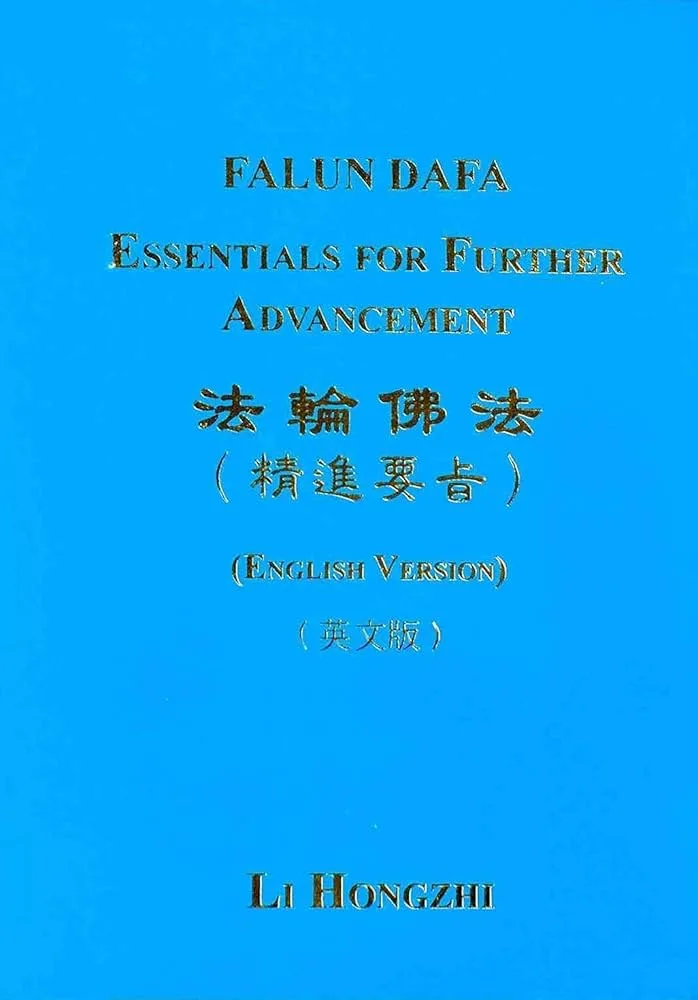
Beyond these two anchor texts, Li has published numerous additional lecture collections and essays over the years, including compilations such as Zhuan Falun (Volume II), Essentials for Further Advancement, Falun Buddha Fa: Lectures in the United States, and a long-running series of shorter published talks and “Fa-rectification” essays addressing current events from the movement’s perspective. These texts describe a layered cosmology involving multiple dimensions, spiritual cultivation, karma, and warnings about moral decline in modern society. Practitioners are expected to study these texts regularly alongside performing the exercises.
Practice and Community Life
Falun Dafa’s five exercises consist of four standing, slow-motion movements and one seated meditation. They are taught free of charge, typically in public parks or community settings, and the movement has historically emphasized that it has no membership rolls, temples, or clergy in the conventional sense. Practitioners gather informally to practice the exercises together and to study Li’s lectures, and they mark occasions such as World Falun Dafa Day, observed annually on May 13 to commemorate the 1992 introduction of the practice.
The 1999 Crackdown and Its Aftermath
Falun Gong’s rapid growth eventually alarmed Chinese authorities. Tensions escalated through the mid-1990s as the movement distanced itself from state-run qigong oversight bodies, and matters came to a head on April 25, 1999, when thousands of practitioners gathered near the central government compound in Beijing to protest what they viewed as unfair media criticism.
The Persecution of Falun Gong (OFFICIAL ENGLISH VERSION)
3D Dialogue: Falun Dafa Part 1
3D Dialogue: Falun Dafa Part 2
Three months later, in July 1999, the Chinese government banned the movement outright, labeling it a threat to social stability, and launched a nationwide campaign against it that human rights organizations say has involved mass detentions, forced labor, and torture of practitioners. Falun Gong-affiliated researchers and some independent investigators, including Canadian human rights lawyer David Matas and former parliamentarian David Kilgour, have further alleged that detained practitioners have been subjected to forced organ harvesting—a claim that has drawn both serious international attention and considerable skepticism from other observers. The Chinese government has consistently denied these allegations and continues to describe Falun Gong as a dangerous cult.
Outside China, Falun Dafa has continued to operate openly, expanding into more than 100 countries through diaspora communities and public outreach. It has also built an extensive media and cultural apparatus, most notably the newspaper The Epoch Times, the broadcaster New Tang Dynasty Television (NTD), and the classical dance company Shen Yun Performing Arts, all of which the movement’s founder has referred to as “our media.” These outlets have drawn scrutiny from journalists and researchers over their finances, editorial independence, and political alignments, adding another layer of controversy to a movement already defined by dispute.
Documentaries and Media Coverage
Falun Dafa and its persecution in China have been the subject of numerous independent documentaries, several of which have been recognized at film festivals:
- Free China: The Courage to Believe (2012) – follows two practitioners’ experiences of imprisonment and persecution in China.
- Human Harvest – examines allegations of forced organ harvesting from detained practitioners, centered on the investigations of David Matas and David Kilgour.
- Hard to Believe – built around journalist Ethan Gutmann’s research into organ harvesting claims.
- Transcending Fear – documents the story of Chinese human rights lawyer Gao Zhisheng, who investigated and publicized accounts of persecution before facing torture himself.
- Nine Commentaries on the Communist Party – a video adaptation of a 2004 editorial series published by The Epoch Times, presenting a critical history of the Chinese Communist Party from the movement’s perspective.
These films are produced largely by practitioner-affiliated or sympathetic organizations, and their claims—particularly around organ harvesting—remain a matter of ongoing debate among journalists, human rights bodies, and medical researchers, some of whom view the evidence as compelling and others as unproven or overstated.
Falun Gong: The Real Story
Unveiling the Truth Behind Falun Dafa
Falun Dafa: The Path to Returning to One’s True Self
Official Websites and Resources
Practitioners maintain several official and semi-official web platforms:
- Falundafa.org – the movement’s primary global site, hosting Li Hongzhi’s lectures, exercise instructions, and background information.
- Minghui.org – the main news and information portal used by practitioners to report on activities and alleged incidents of persecution in China.
- The Epoch Times (theepochtimes.com) and NTD.com – news outlets associated with the movement’s broader media network.
- ShenYun.com – the site for Shen Yun Performing Arts, the classical Chinese dance and music company associated with the movement.
Conclusion
Falun Dafa occupies an unusual position in the contemporary religious and political landscape: a meditation-based spiritual movement whose modest exercise routines exist alongside a sprawling international media presence and a decades-long, deeply contested human rights dispute with the Chinese state. For practitioners, it remains a path of moral cultivation rooted in Li Hongzhi’s teachings.
For the Chinese government, it remains a banned organization. And for outside observers—journalists, scholars, and human rights investigators—it remains a subject demanding careful, evidence-based scrutiny rather than easy conclusions in either direction. Anyone researching Falun Dafa is well served by consulting a range of sources, from the movement’s own publications to independent journalism and human rights reporting, in order to form a complete picture of a movement whose story is still being written.