

Alfred (Antoine) Bovis
The Legacy of Antoine Bovis: Exploring Radiesthesia, Pyramid Power, and Subtle Energies

Introduction: Antoine Bovis and the Quest for Subtle Energies
Antoine Bovis, formally known as Alfred (Antoine) Bovis (1871-1947), was a French figure whose diverse background as an ironmonger, physicist, and archaeologist laid the foundation for his pioneering work in the realm of subtle energies. Born in Nice, France, Bovis dedicated a significant portion of his life to exploring the invisible forces that he believed permeated all matter and living organisms. His primary fascination revolved around devising a quantifiable method to measure what he termed the “Life Force Index” generated by places, people, animals, plants, and even food.
Bovis’s work emerged during a transformative period in scientific thought, contemporary with Albert Einstein, when the profound relationship between matter and energy was being rigorously re-examined. This era saw the notion of matter constantly emanating subtle energy shift from being a subject of jest to a more plausible, albeit unproven, hypothesis within certain circles. Bovis’s efforts to quantify these elusive energies, particularly his interest in identifying foods that contribute to vitality versus those that weaken it, positioned him at a unique intersection of empirical observation and speculative science. This report delves into Bovis’s methods, his most notable contributions, the subsequent popularization of his ideas, and the critical scientific evaluation of his legacy, including a comprehensive list of his known works and relevant media.
The Bovis Scale: A Biometer for Life Force
The Bovis Scale, also known as the Biometer, originated from Antoine Bovis’s observations in the 1930s, where he reportedly noticed differences in energy levels surrounding the Great Pyramids. While a persistent story suggests he observed non-decaying animal carcasses inside the King’s Chamber of the Great Pyramid, Bovis himself never claimed to have visited Egypt for this specific observation, attributing his discoveries to experiments conducted in Europe. His ambition was to create a tool that could measure the “Life Force Index” of various entities, from geographical locations to the food we consume. He was particularly motivated by the desire to identify foods that enhance vitality and eliminate those that might compromise the immune system.
The Bovis Scale
Let’s analyze… Alfred Bovis, and the vibrational rate concept
Brief History of Piramicasa and Pyramidology Vital Pyramid
The methodology of the Bovis Scale employs empirical tools such as dowsing forks or a pendulum. A practitioner positions an object next to a physical Bovis scale and holds a pendulum over it. The premise is that invisible radiation emanating from the object causes the pendulum to move, pointing towards a specific number on the scale. Bovis’s original scale ranged from 0 to 18,000 units, with 6,500 established as a neutral point. Readings below 6,500 were considered indicative of negative or weakening energies, while those above suggested positive, vitality-contributing energies. Beyond food, Bovis also applied this approach to measure the energetic frequency of sacred sites and other places on Earth.
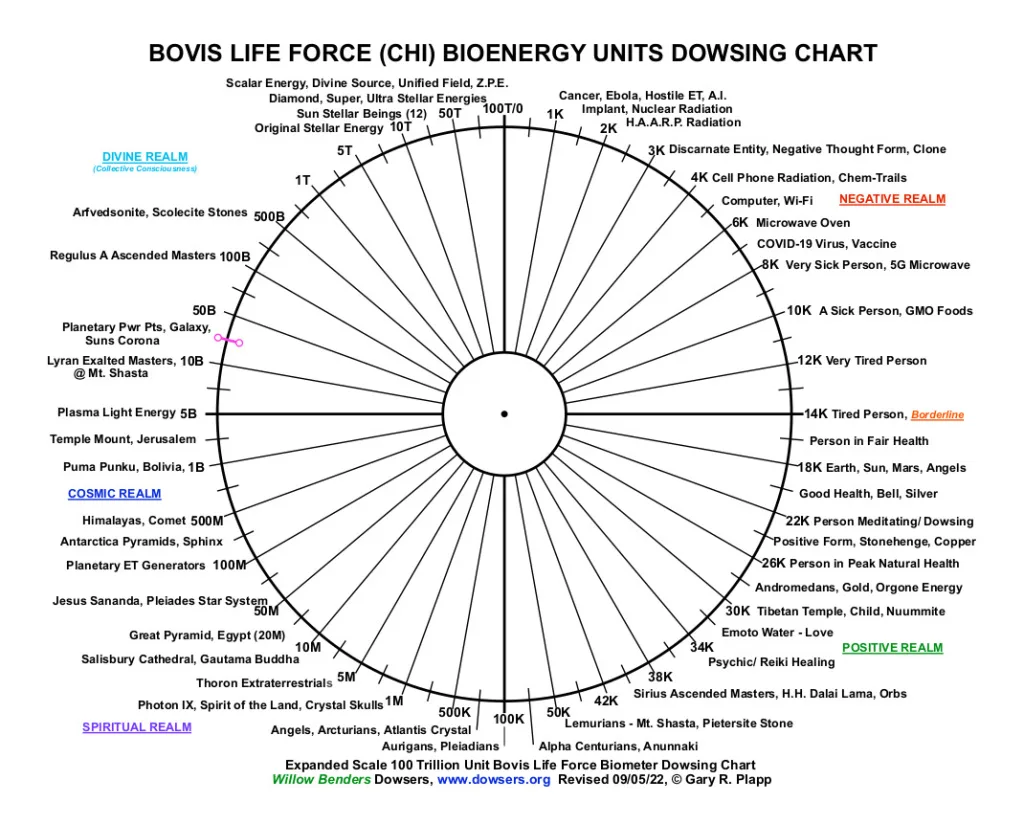
He used this chart to determine relative levels of beneficial energy or Chi. His limit was 18K – we’ve come a long way since then. The Bovis Scale quantifies or measures levels of vitality and energy of being from non-existence to the highest level possible in our perceived reality. The labels are things referenced to associated values. Beyond the red bar (≈30B) is thought to be ‘outside the box’, beyond perceived reality, termed Reality. (Pure Consciousness).
NOTE: For all people who are interested in dowsing and to get a printable version of the Bovis Chart, please visit Gary Plapp’s website at https://photonrevelations.com/bovis-chart/
and the American Society of Dowsers at https://dowsers.org/ for more information.
Proponents of the Bovis method often interpret its measurements as quantifying the intrinsic photon energy, or biophotons, of a person, place, or object. This perspective suggests that a positive, life-enhancing value on the Bovis scale correlates with a counterclockwise spin of atoms, whereas a clockwise spin results in a weakening reading below 6,500. For instance, human DNA and pure living water are said to exhibit a counterclockwise spiral, while cancer cells and “dead” water show a clockwise spin. The minimum vibratory rate for a human being is generally cited around 8,000 Bovis units, with some suggesting this rate is accelerating to align with Earth’s perceived vibrational increase. Negative emotions and destructive habits are believed to decrease this vibratory rate, compromising vitality and the immune system, while high-frequency foods and positive lifestyle choices are thought to enhance it. Modern applications even extend to “quantum skincare” products, which claim to register extremely high Bovis units (e.g., 18,000), linking this to “subtle” or “spiritual” levels and aligning with a “quantum” definition.
3 Bovis Scale Bio meters
Learn to use a Pendulum (Pro Pendulum Dowsing Tutorial for beginners)
Pendulum tuning 1
The development of the Bovis Scale represents a compelling attempt to quantify an intangible concept, reflecting a broader human inclination to measure and potentially control unseen forces. Bovis’s ambition to assign numerical values to “life force” or “vital rays” emerged at a time when the scientific community was grappling with revolutionary concepts in physics, such as Einstein’s work on matter and energy. This historical context suggests that Bovis, like many others, was exploring new frontiers of understanding, albeit through a methodology that diverged significantly from conventional scientific rigor. The scale’s enduring appeal in alternative practices underscores a persistent desire to find measurable indicators for well-being and environmental quality, even when those measurements lack a basis in established physics.
Radiesthesia: The Underlying Methodology
Radiesthesia serves as the foundational methodology for Antoine Bovis’s work, including the operation of the Bovis Scale. It is described by its practitioners as a physical ability to detect radiation emitted by various sources, including living beings, inanimate objects, mineral ores, water, and even photographs. J. Cecil Maby, a practitioner, defined it as “The faculty and study of certain reflexive physical responses of living tissue to various radiations resulting in displacement currents and other inductive effects in living tissues,” critically distinguishing it from purely psychic divination.
The term “radiesthesia” itself is a neologism coined in 1927 by Alexis Timothée Bouly, a French Catholic priest and celebrated dowsing practitioner of the early 20th century. Bouly claimed remarkable abilities, such as detecting unexploded ordnance from World War I and identifying molecular changes in laboratory experiments. He further formalized the practice by founding the Association of the Friends of Radiesthesia (Association des Amis de la Radiesthésie) in Lille in 1929).
Bovis Scale For Measuring Subtle Energy Fields
Earth Grids and Ley Lines | The Invisible Super-Science of the Megalith Builders
#016 Valerie Holgan: Stargates, Ley lines, Sacred Geometry and meditation
In practice, radiesthesia typically involves the use of empirical tools like dowsing rods or a pendulum. Practitioners interpret the movements of these instruments as indicators of the presence or state of the subject under investigation. The practical applications claimed for radiesthesic techniques are broad, encompassing the diagnosis of infirmities, the detection of underground water and mineral sources, the location of Earth’s telluric currents and magnetic fields, and even the finding of lost objects or missing persons. This methodology underpins the Bovis Scale’s operation, where the pendulum’s movement over an object is interpreted to yield a numerical “energy” reading.
The historical practice of dowsing, from which radiesthesia evolved, has a long-standing presence as a method for locating hidden elements, particularly water. Bovis’s contribution was to move beyond simple “yes/no” detection, as is common in traditional dowsing, to an attempt at quantifying these perceived energies with a numerical scale. This shift represented an effort to imbue a subjective practice with a semblance of scientific precision, seeking to measure and categorize subtle phenomena rather than merely detect them. This evolution from qualitative detection to quantitative assessment, even if lacking in scientific basis, marks a significant conceptual development within the field of radiesthesia.
The Pyramid Power Phenomenon
Antoine Bovis is widely associated with the concept of “pyramid power,” an idea he developed in the 1930s concerning the purported ability of pyramid shapes to preserve food. The popular narrative often recounts Bovis observing non-decaying dead animals in a garbage can within the King’s Chamber of the Great Pyramid in Egypt, leading him to infer the structure’s preservative properties. However, Bovis himself never claimed to have visited Egypt, stating in his self-published French booklet that his discoveries stemmed from reasoning and experiments conducted in Europe using a dowsing pendulum. He hypothesized that ancient Egyptians were skilled dowsers who oriented their pyramids using rods and pendulums. Unable to travel to Egypt, he constructed cardboard pyramids and reported success in preserving small fish and meat, observing desiccation without decay.
Inspired by Bovis’s work, Karel Drbal, a Czechoslovakian radio engineer, applied for a patent in 1949 for a “Pharaoh’s shaving device”. This model pyramid was alleged to maintain the sharpness of razor blades.5 Drbal’s patent (#91,304) claimed the method involved placing razor blades in a magnetic field, with the sharp edge aligned with magnetic lines, suggesting his device would focus “the earth’s magnetic field”. It is notable that claims of sharpening razors by aligning them with Earth’s magnetic field predated Drbal, with The Times publishing similar assertions as early as 1933.
The Megalithic Solstice Line of Southern England | Howard Crowhurst
Energy Portals – Ley Lines
Energy clearing part 1
The concept, which became widely known as “pyramid power,” gained significant traction in the English-speaking world following the 1970 publication of Psychic Discoveries Behind the Iron Curtain by Sheila Ostrander and Lynn Schroeder. This book, featuring Drbal’s work and Bovis’s story, ignited a “craze” in the mid-1970s, further fueled by speculative claims from figures like Erich von Däniken, who suggested the pyramidal shape itself was inherently “magical and filled with a mysterious energy and power”.
This popularization led to real-world, albeit unverified, applications, such as the construction of the “Pyramid House” in Gurnee, Illinois, in 1977, and the Summerhill Pyramid Winery in British Columbia, which claimed improved wine quality when aged within a four-story pyramid replica.
The widespread dissemination of “pyramid power” through popular media served as a powerful catalyst, transforming Bovis’s relatively obscure dowsing experiments into a significant cultural phenomenon. The transition from a niche, empirical (though unscientific) “discovery” to a widely recognized and marketable “power” illustrates how ideas, regardless of their scientific validity, can achieve considerable public traction and commercial exploitation when effectively communicated and when they align with broader cultural fascinations, such as ancient mysteries or hidden energies. This process often detaches the concept from its original context and nuances, allowing for broader, often unverified, applications.
Scientific Scrutiny and the Pseudoscience Classification
Despite the popular appeal and enduring influence of Antoine Bovis’s concepts, mainstream science has consistently classified radiesthesia and “pyramid power” as pseudoscience. Radiesthesia, while distinguished by its practitioners from purely psychic abilities, lacks any scientific evidence for its existence. This classification is fundamental to understanding the scientific community’s stance on Bovis’s core methodology.
Critiques of the Bovis method highlight its fundamental lack of scientific grounding. The scale relies “solely on dowser intuition,” and the unit of measurement itself has “no known definition and isn’t in any way based on physics”. This represents a significant departure from standard scientific metrology, which demands objective, reproducible measurements. A major scientific concern is the inherent difficulty in reproducing the experiments in a classical scientific sense. Critically, Bovis himself “did not believe in the scientific method nor in conducting proper scientific experiments with full documentation”. He made no attempt to present his findings to scientific societies for peer review, comment, or criticism, nor did he facilitate the duplication of his experiments for verification. This “failure or refusal” to engage with established scientific protocols is noted as a likely reason for a “fifty-year set-back to the serious scientific examination of his data”.
The scientific community offers a well-established explanation for the observed movements in dowsing instruments: the “ideomotor phenomenon”. This refers to “involuntary bodily reactions” where “suggestions and expectations can trigger muscle movements which bypass our will,” creating the illusion that an external force is moving the pendulum or rod.7 This unconscious muscular activity is considered the true initiator of the movement observed by practitioners.
Empirical tests have been conducted to evaluate “pyramid power” claims. A notable example is the MythBusters episode in 2005, which performed controlled tests on assertions such as food preservation and razor blade sharpness within pyramids. The findings showed “no significant difference between items in pyramids and outside” when proper control protocols were in place. Similarly, rigorous German trials on dowsing have consistently demonstrated that practitioners perform no better than chance at locating hidden objects like water.
The fundamental conflict at the heart of Bovis’s legacy lies in his preference for “intuition and faith” over the rigorous demands of the scientific method. Scientific inquiry mandates empirical evidence, testable hypotheses, reproducibility, and peer review. The consistent critiques of the Bovis Scale emphasize the absence of objective, measurable phenomena and its reliance on subjective interpretation. The ideomotor effect provides a well-substantiated, non-supernatural explanation for the observed movements, effectively challenging the claims of external energy detection. This fundamental methodological divergence explains why Bovis’s concepts, despite their enduring appeal to certain communities, remain classified as pseudoscience. The consistent failure of controlled experiments to validate his claims further underscores this classification.
Legacy and Enduring Influence
Despite the scientific classification of his work as pseudoscience, Antoine Bovis’s initial concepts have demonstrated remarkable adaptability and enduring influence, adopted and expanded upon by subsequent figures. Dr. Oscar Brunler, for instance, refined Bovis’s scale and notably reinterpreted its measurements as corresponding to “quantum emissions of light” or “vital rays,” introducing a more modern, albeit still pseudoscientific, vocabulary. André Simoneton further developed the concept by introducing the term “radio-vitality” (radiovitalité). Blanche Merz contributed to the development of a “modern Bovis scale” and established an “Institut de recherches en geobiologie,” indicating a formalization and institutionalization of these ideas within certain communities.
The Bovis Scale and the broader concepts it represents continue to find application in various alternative practices. It remains a tool used by dowsers and adherents of geomancy to quantify what they perceive as “cosmo-telluric energy” at different locations, assessing the “energetic quality” of places, objects, and even individuals. In more contemporary applications, the Bovis Scale is cited in the marketing of “quantum skincare” products. Some of these products claim to register at very high Bovis units (e.g., 18,000), linking this to “subtle” or “spiritual” levels and aligning with a “quantum” definition. Similarly, “biophoton generators” are promoted with claims of enhancing seed germination, preserving produce, and boosting fermentation, with their effects purportedly measurable by the Bovis scale. The core concept of influencing personal vitality through “energy” levels also persists, with proponents suggesting that consuming foods with high Bovis unit readings and cultivating positive emotions can increase one’s “vibratory rate,” thereby enhancing overall vitality and immune function.
The evolution of Bovis’s original concept, from a simple “life force” measurement to incorporating terms like “quantum emissions of light” and being applied to modern commercial ventures, illustrates a significant pattern in the longevity of pseudoscientific ideas. These concepts often do not simply fade away when scientifically debunked. Instead, they adapt, adopting new terminology that incorporates contemporary scientific-sounding jargon (“quantum,” “biophoton”), expanding their scope of application, and frequently finding new commercial avenues. The very lack of a strict scientific definition or objective measurement allows for broad, often unverified, applications and continued market appeal. The Bovis Scale, rather than being a static historical curiosity, has become a flexible and evolving framework for various alternative practices, demonstrating the resilience of ideas that resonate with a desire for holistic well-being and unseen influences.
Antoine Bovis: A List of Known Works
Antoine Bovis is primarily recognized for his foundational self-published French-language booklet, Methode Nicoise de radiesthesie. This booklet, published around 1935, serves as the primary text detailing his dowsing experiments and the underlying principles of his concepts.
Beyond this seminal publication, research indicates that Bovis was also an inventor who secured several patents, reflecting his attempts to formalize and apply his theories through tangible devices. These patents underscore his practical, mechanical background as an “ironmonger”.
The existence of Bovis’s patents for inventions like determining egg freshness and producing “magnetic waves” presents a more complex and nuanced profile than a simple “occultist” label might suggest. His background as an ironmonger further points to a practical, mechanical inclination. This information reveals that Bovis was not merely a speculative thinker or mystic; he was also an inventor who actively sought to apply his understanding of unseen forces—whether perceived as magnetic waves or “radioactive radiations”—to create tangible devices. These patents, even if their underlying principles are not scientifically validated, demonstrate an attempt to formalize and operationalize his theories through invention, painting a more comprehensive portrait of a figure who bridged the worlds of practical engineering and speculative energetic concepts.
Documentaries and Films Related to Bovis’s Concepts
While Antoine Bovis significantly influenced the “pyramid power” phenomenon, there appear to be no documentaries created exclusively about Bovis himself based on available research. This distinction is crucial for clarifying the nature of his media presence.
Despite the absence of direct biographical films, Bovis’s influence and the concepts he championed are touched upon in broader media contexts:
The noticeable absence of documentaries exclusively dedicated to Antoine Bovis, despite his significant influence on the “pyramid power” phenomenon, is a key observation. Instead, his ideas are consistently woven into broader narratives about ancient mysteries, pseudoscientific debunking efforts, or even fictional horror genres. This pattern suggests that while Bovis’s concepts achieved considerable cultural resonance and popular notoriety, Bovis himself remained a less central figure in the public imagination compared to the phenomena he described.
His media legacy is primarily indirect, manifested through the impact of his concepts on popular culture and the scientific community’s subsequent responses, including debunking efforts, to these widely accepted notions. This also highlights a common challenge in researching figures associated with fringe ideas, where their influence is often diffuse, intertwined with broader cultural trends, and rarely the subject of direct biographical media attention.
Conclusion: A Figure at the Crossroads of Science and Speculation
Antoine Bovis emerges as a fascinating historical figure, an ironmonger and radiesthesist who, in the early 20th century, embarked on a distinctive quest to quantify what he believed were subtle energies. His development of the Bovis Scale and his experiments with pyramid power represent a unique attempt to bridge the gap between empirical observation—however unscientific—and the then-emerging, revolutionary understanding of the relationship between energy and matter.
However, it is crucial to reiterate that while Bovis’s work undeniably sparked significant public interest and continues to influence various alternative practices, his methods and findings—particularly the Bovis Scale and the concept of pyramid power—lack scientific validation. Mainstream science attributes the observed phenomena to subjective effects, most notably the ideomotor phenomenon, where unconscious muscle movements, influenced by suggestion and expectation, are responsible for the perceived movement of dowsing tools. Bovis’s apparent reluctance to engage with the rigorous protocols of the scientific method, such as peer review and documented reproducibility, significantly hindered any serious scientific examination of his claims. His preference for “intuition and faith” over systematic empirical testing created a fundamental divergence from established scientific inquiry.
Despite being classified as pseudoscience by the mainstream scientific community, Bovis’s ideas have demonstrated remarkable endurance and adaptability. They have been refined and expanded by others, incorporating new scientific-sounding terminology like “quantum emissions of light” and “radio-vitality,” and finding new applications in fields such as alternative health, geomancy, and the marketing of “quantum” products. Antoine Bovis ultimately stands as a compelling symbol of humanity’s persistent quest to understand unseen forces, a figure situated at the compelling intersection of historical scientific curiosity and enduring speculative thought. His legacy continues to resonate within communities seeking alternative explanations for vitality and environmental influences, even as his methods remain outside the purview of conventional scientific acceptance.